

On May 30, the 10th National Day for Science and Technology Workers arrived as scheduled. Recently, the Publicity Department of the CPC Central Committee and the China Association for Science and Technology released the exemplary stories of the “Most Beautiful Science and Technology Workers” to the public. With a deep sense of national responsibility, they have adhered to the “Four Orientations,” remained true to their original aspiration of serving the country through science and technology, and demonstrated the uplifting spirit of science and technology workers in the new era.
Dedicated to Tackling Challenges, Forging Major National Projects
Forging two major national projects has been the highlight of Xu Hongjie’s career. He previously served as Director of the Shanghai Institute of Applied Physics at the Chinese Academy of Sciences, General Manager of the Shanghai Synchrotron Radiation Facility (a national major scientific project), and Head of the Thorium-based Molten Salt Reactor Nuclear Energy System Pilot Project at the Chinese Academy of Sciences.
By the 1990s, Xu Hongjie had already made a name for himself in the field of atomic physics in China. After taking on the heavy responsibility of building a third-generation synchrotron radiation source, he put his personal research on hold and led a young team to tackle the challenge. Once the Shanghai Synchrotron Radiation Facility was completed and began operations, he turned his attention to the “uncharted territory” of the nuclear energy sector—the thorium-based molten salt reactor.
“Meeting national needs is the sacred duty of scientists and engineers,” Xu Hongjie once said. Whether it was dedicating himself to building the Shanghai Synchrotron Radiation Facility—a major national project—or tackling the world-class challenges of thorium-based molten salt reactors from scratch, both required immense courage and tenacity. With extraordinary resolve and a hands-on approach, Xu Hongjie led his team in turning blueprints into reality.
Major national projects are often a concentrated manifestation of a nation’s scientific and technological innovation capabilities and comprehensive national strength. In recent years, China has seen a succession of major national projects come to fruition, thanks to the dedicated efforts and relentless hard work of countless scientists and engineers.
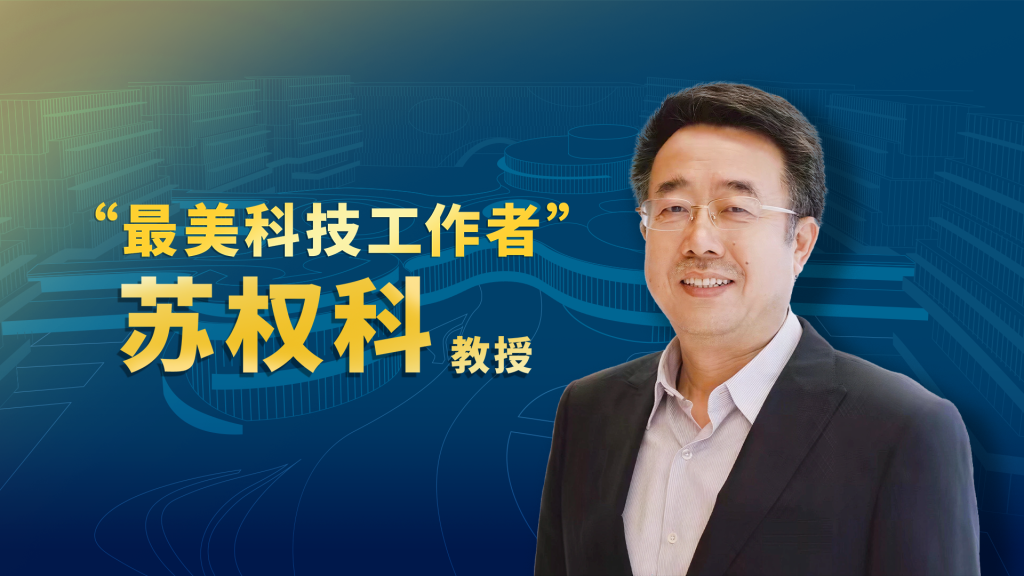
A design life of 120 years—how could such an extremely high standard be achieved? This challenge fell to Su Quanke, Chief Engineer of the Hong Kong-Zhuhai-Macao Bridge project, and his team.
To achieve this goal, Su Quanke visited cross-sea engineering sites in more than a dozen countries, rigorously evaluated hundreds of design proposals, and led his team in overcoming key technical challenges for the long-term construction of bridge-island-tunnel structures in marine environments. He established a reliability-based durability design theory, which has been dubbed the “Hong Kong-Zhuhai-Macao Model” by international peers.
“The Hong Kong-Zhuhai-Macao Bridge is a world-class physical bridge; in the future, we aim to transform it into a world-class digital bridge.” Su Quanke and his team have now turned their attention to researching digital and intelligent operation and maintenance management to further extend the service life of the Hong Kong-Zhuhai-Macao Bridge.
Addressing the challenge of navigation control for high-inertia vehicles in the extreme environment of the deep ocean, Zhao Yang—a senior engineer at the Shenyang Institute of Automation of the Chinese Academy of Sciences and deputy chief designer of the “Fendouzer” full-ocean-depth manned submersible—led his team in overcoming multiple key technical hurdles. They successfully developed the “Fendouzer” control system independently, achieving internationally advanced standards.
In November 2020, Zhao Yang boarded the “Fendouzhe” submersible and descended to a depth of 10,909 meters in the Mariana Trench, becoming one of the first three Chinese submersible pilots to reach the deepest point in the world’s oceans.
Brave Exploration, Advancing to the Frontiers of Science and Technology
Jin Haizu is the Director of the Aviation and Robotics Battery Technology Center at Contemporary Amperex Technology Co., Ltd. (CATL). She led her team in developing high-energy-density lithium-ion batteries, whose energy density reached internationally advanced levels, filling a domestic technological gap.
As the volume of experimental data accumulated during battery R&D grew, Jin Haizu keenly realized that the value of this data had not yet been fully tapped. In 2021, with forward-looking strategic vision, she initiated the development of an AI-powered smart design system for battery cells, driving a transformation in R&D models from “experience-driven” to “data and AI-driven.”
“The mission of scientists is not only to solve the immediate ‘bottleneck’ challenges but also to have the courage to build new paradigms that support the industry’s high-quality development,” said Jin Haizu. After arduous research and development efforts, she and her team developed an intelligent R&D system covering four major platforms: “intelligent design, data management, knowledge engineering, and collaborative management.”
By targeting the forefront of science and technology and strengthening the foundation of innovation, the courageous exploration of a vast number of scientific and technological workers has led to a continuous stream of high-quality research results.
Epilepsy is classified by the World Health Organization as one of the chronic neurological diseases with the heaviest disease burden. Among women of childbearing age with epilepsy, rates of infertility, maternal mortality during pregnancy, and congenital malformations in offspring are several times higher than in the general female population.
Chen Lei, Vice Dean of the West China School of Clinical Medicine at Sichuan University and Chief Physician at West China Hospital of Sichuan University, has tackled the challenges of epilepsy in women of childbearing age head-on. Leading her team, she established the world’s first ontology database for the diagnosis and treatment of female epilepsy, achieved breakthroughs in key epilepsy early-warning technologies, and built a full-lifecycle management system, significantly reducing rates of infertility and fetal malformations among patients.
Gui Haichao, a professor at Beihang University, was the first payload specialist on China’s space station. Throughout the mission, he worked closely with the crew to complete 68 space science experiments covering key fields such as microgravity fluid physics, materials preparation, and life sciences, driving significant progress in multiple research areas.
Upon returning to the front lines of teaching and research, Gui Haichao embarked on a new journey: leading his team to address major needs for China’s future space development by researching key technologies such as space perception, motion planning, and precision manipulation for in-orbit servicing, space debris monitoring, and removal…
Rooted on the Front Lines, Demonstrating Practical Action and Responsibility
Standing firm on the front lines of cave relic conservation, Yu Zongren, Director of the Conservation Research Institute at the Dunhuang Academy and Senior Researcher, is dedicated to safeguarding the cultural relics of the Dunhuang Grottoes through science and technology.
Addressing the various “ailments” affecting murals and colored sculptures, Yu Zongren proposed the research objective of “seeing clearly, understanding thoroughly, and managing effectively,” making significant contributions to shifting cultural relic conservation from empirical judgment to scientific decision-making, and from post-incident rescue to proactive prevention.
Yu Zongren applies in-situ non-destructive analysis techniques to conduct “health checkups” on the caves, using data to accurately “diagnose” millennia-old murals and systematically establish a “health assessment” and multi-dimensional monitoring system for murals. The technologies and methods developed by the Dunhuang Academy’s cultural heritage conservation team have set an important example for the protection of cave murals nationwide.
“Scientific research must be grounded in the most authentic field data,” said Kong Hainan, Chair Professor at the School of Environmental Science and Engineering at Shanghai Jiao Tong University. To advance the scientific management of Erhai Lake, he moved his “laboratory” to the field. Over the past decade, he has spent more than 200 days a year stationed at Erhai Lake, traversing every village and river around the lake to identify every source of pollution.
He led his team in conducting 30,000 samples and 160,000 water quality analyses, using this massive volume of first-hand data to lay a solid foundation for the scientific management of Erhai Lake.
Song Rende, Director of the Animal Disease Prevention and Control Center of Yushu Tibetan Autonomous Prefecture in Qinghai Province and a Senior Researcher, is affectionately known by herders as the “Yak Doctor” who has put down roots on the plateau.
Addressing the “three lows” challenge facing Yushu yaks—low reproduction rates, low market yield, and low income for herders— Song Rende developed and promoted an eco-efficient “grazing plus supplementary feeding” breeding technique for yaks. Leading his team across every township in Yushu Prefecture, he collected superior genetic resources, established comprehensive breed records, and innovatively proposed an integrated “selection-breeding-promotion” model alongside the “seed industry-driven model” for Yushu yaks, thereby constructing a “three-tier breeding system” for the species. The “Yushu Yak” and “Zashiga Sheep” breeds he helped select and breed were successfully included in the National Livestock and Poultry Genetic Resources Catalog and passed breed certification. His efforts also led to the inclusion of Yushu Yak in the National Catalog of Famous, Special, Superior, and New Agricultural Products and its upgrade to a National Geographical Indication Protected Product.
Huang Guiyun, Deputy Director of the Yangtze River Biodiversity Research Center at China Three Gorges Corporation, has worked on the front lines of protecting endangered and rare plants in the Three Gorges region for over 30 years. She has spearheaded the conservation of more than 2,130 species of endangered endemic plants, propagated over 320,000 seedlings, and established the country’s largest germplasm repository for endangered, rare, and endemic plant resources.
In recent years, Huang Guiyun has actively engaged in science popularization, communicating with the public in their own vernacular and conveying genuine care, while sowing the seeds of science among young people. Her online science popularization lectures have reached a cumulative audience of over 10 million people.
Source: People’s Daily
The English version is provided for reference only.
The Chinese version shall prevail in case of any discrepancies between the English and Chinese versions